
Strength and Hanging
Strength is trained between flights and decides how long you can hold on before your grip fails. Heavier planes reward more but drain a weak grip faster, so strength and gloves are the pair that unlocks the mid-game.
Every failed hang in Catch a Plane looks like a different mistake and is usually the same one: your grip ran out before the plane did. Strength is the stat that decides how long that takes, and it is the only upgrade in the game you cannot buy.
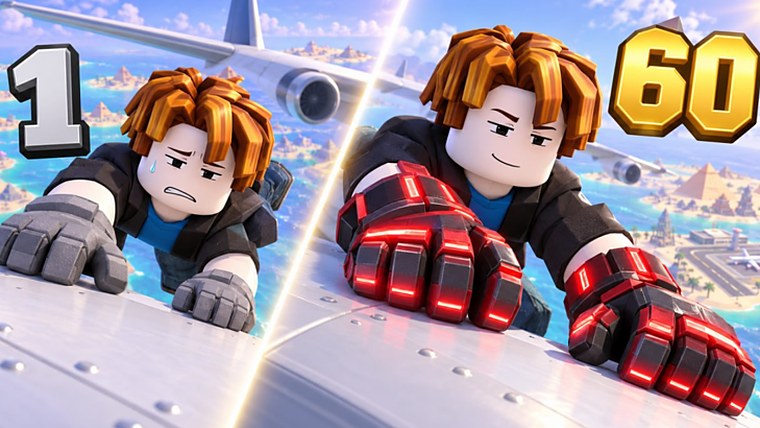
Grip is a timer
The description puts it in one line — train your strength to hold on longer — and that sentence tells you everything about the shape of a run. Hanging is not a check you pass or fail; it is a countdown that starts the moment you take hold.
Three implications follow, and each one changes how you play:
- Time in the air is the resource. Every second attached is a second of progress and a second of drain, at the same time.
- A catch is a commitment. You are spending grip the instant you grab, so a catch on a plane going nowhere is a pure loss.
- Dropping is not failing. Releasing with grip left is how you keep altitude, pick a second plane and turn one hang into a route.
Players who understand only the first of those ride planes until they fall. Players who understand all three start chaining catches, and that is when distance jumps.
What strength changes, and what it does not
| Strength affects | Strength does not affect |
|---|---|
| How long you can hold before the grip fails | Which planes you can catch |
| How much margin you have on heavy planes | How fast you grab |
| How far a single hang can carry you | Gear box contents |
That split is the reason strength and gloves are usually discussed together. Gloves widen the set of planes you can take; strength decides how long you keep them. Buy gloves without strength and you catch more planes you cannot hold. Train strength without gloves and you hold easy planes longer than you need to.
The pair works when they are close to each other. If one is far ahead, you are wasting it.
Why heavy planes punish a weak grip
Gloves are described as letting you grab faster and heavier planes. Weight is the part that interacts with strength: a heavier aircraft is a bigger load, so the same grip lasts less time.
That creates a visible failure pattern:
| What you see | What it is |
|---|---|
| You catch the heavy plane and drop in seconds | Strength too low for that plane class |
| You cannot catch the heavy plane at all | Glove tier too low |
| You catch it, hold it, and still get nowhere | The plane was not going anywhere useful |
Only the first column is about strength. The second is gloves, the third is route reading — and players routinely train strength to fix the third.
Training, in practice
Strength is trained rather than purchased, so the only question is when to spend the time. Three rules cover it.
- Train before chasing a harder plane class. A heavy plane on a weak grip wastes both the jump and the grip.
- Train after every glove upgrade. You just widened the set of planes you can catch; strength is what lets you keep them.
- Do not stockpile training for later. Strength compounds through every run it applies to, so raising it early pays out more times.
If you are choosing between one more run and one more training step, and your grip is what has been failing, take the training.
The release skill nobody teaches
Holding on is the obvious half of the mechanic. The other half is letting go on purpose, and it is where distance actually comes from.
| Habit | Result |
|---|---|
| Ride until the grip fails | Every run ends wherever the drain ended |
| Release with grip left, aim the fall | Fall becomes travel toward the next plane |
| Release into a second plane | Two hangs, one run, more distance |
| Release with nothing in sight | Wasted altitude — the one bad release |
The difference between the first and third rows is the whole skill curve of Catch a Plane. It also explains why strength has a ceiling on usefulness: past a point, more grip just means you can make the same mistake for longer.
Gear and the grip timer
Gear boxes give you jetpacks, parachutes and Gravity Wings — movement tools. None of them is described as changing your grip, and this page will not claim otherwise.
What they do change is what a release costs you:
- A parachute turns a drop into a controlled descent, so releasing early is less risky.
- A jetpack adds thrust, which can put you back in reach of a plane you released too soon.
- Gravity Wings give you a third way to cross a gap between catches.
In other words, gear does not extend the timer, but it makes the moments after the timer matter less. That is why the recommended order is strength first, then gear.
Practising the timer without wasting runs
You can train the grip sense in ordinary play rather than in special sessions. Pick a plane you know is easy, count how long the hold lasts, and do it again with a heavier one. The difference between the two counts is your margin, and it is the number that tells you whether the next plane class is worth attempting.
Most players never measure that, then conclude the game is random when a heavy plane drops them at what feels like the same point every time. It is not random; it is a shorter timer on a bigger load.
How to tell you have enough strength
Two signals, and either one is enough to move on.
First: you are dropping planes you were happy to catch. If the failure is the hold rather than the catch, strength is still the constraint.
Second: your releases are landing where you want. If you can let go and reliably reach the next plane, your grip is no longer the bottleneck — your route reading is now the skill to improve.
At that point the money goes to gloves or a zone, not to more training.
The short version
- Strength sets how long you hang; gloves set what you can grab.
- Heavy planes cost more grip, so gloves without strength is a trap.
- Release early on purpose: distance comes from chaining catches, not from one long ride.
- Gear does not extend the timer, it just makes releasing cheaper.
- Train after every glove upgrade, and stop when your releases land.
For the wider picture, Progression puts these upgrades in order, Gloves and Gear covers the other half of the pair, and How to Play is the loop these mechanics sit inside.