
How to Play Catch a Plane
Jump at a plane that is passing low, press grab the moment your hands reach the fuselage, then hold on and steer your body against the drag. Your grip drains while you hang; when it empties you drop, so hang, release and re-grab instead of riding one plane forever.
A run in Catch a Plane is five seconds of reading, one second of timing and then however long your grip lasts. You stand on the ground, an aircraft comes across your line, you jump to meet it, you take hold of the fuselage, and the plane keeps going — dragging you through the air while your hold drains. Everything else in the game, every glove, every gear box, every pass, exists to make that one sequence longer or more valuable.
What makes it hard is that the plane does not slow down for you and it does not come back. You are not boarding anything. You are intercepting it.
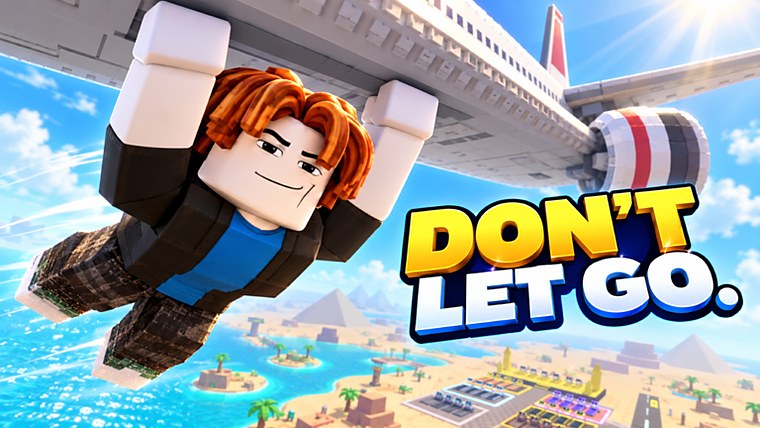
What you actually do in a run
- Watch the approach. Stand where you can see aircraft coming rather than looking at your character. The horizon line tells you what is coming; your character does not.
- Pick your plane. A plane that is low and slow is a beginner catch. Anything high, fast or far off the line is a plane you will waste a jump on.
- Jump to meet it, not to chase it. You want to arrive where the plane will be, so the jump starts slightly before the aircraft reaches you.
- Take hold. The catch happens at the aircraft body. If you are short, you fall; if you are early, the plane passes behind you.
- Ride, then let go on purpose. Hanging burns your grip continuously. Once you know where the finish is, dropping early and setting up the next catch is often better than riding until your hands fail.
That last point is the first real skill: new players ride until they fall, so every run ends wherever the grip ran out. Release while you still have height and the fall becomes travel instead of a reset.
Why you get thrown off
Getting thrown off is not a random punishment; it is the grip timer running out. The developer's own description names the fix in the same breath as the mechanic: train your strength to hold on longer. That sentence is the whole answer to "why do I keep falling".
Three things make the timer run out sooner than you expect:
| What happens | Why it feels sudden | What actually changed |
|---|---|---|
| You catch a heavier plane | The catch itself felt fine | Heavier planes were always going to cost more grip |
| You ride without adjusting | The sky looks calm | Grip drains continuously while you hang |
| You chain catches with no recovery | Each catch succeeded | Nothing refills the timer between catches |
The practical version: treat every hang as a spend, and only spend when the plane is taking you somewhere you want to be.
Reading a plane before you jump
The game distinguishes planes by how hard they are to grab and how heavy they are — that is exactly what glove upgrades are for. So the most useful habit in your first hour is simply looking at aircraft before you commit.
- Low and slow is a starter plane. Close to the ground, easy to reach, easy to release.
- Fast and straight is a plane that punishes a late jump. Lead it more.
- Heavy planes are the ones gloves unlock. If a plane consistently slips through your catch, that is a glove problem, not a timing problem.
- Far off your line is usually not worth it. Two clean catches on easy planes beat one heroic miss.
What you can rely on is the relationship the game itself states: stronger gloves, heavier planes.
What a good jump looks like
A clean jump is unspectacular. You are standing still, the plane is a second away, and you leave the ground once — no second jump, no chasing. The catch happens on the way up or at the top of the arc, and from there the plane carries you.
A bad jump has a signature too: you jump early, the plane passes in front of you, and you are already falling when it goes by. If that keeps happening, you are reacting to the plane rather than to where it is about to be.
Controls, and what each input is for
Catch a Plane runs on Roblox's standard client controls, so nothing here is exotic:
- Move: WASD or the arrow keys on PC, the left thumbstick on a controller, the on-screen stick on mobile.
- Jump: Space on PC, the jump button on mobile, the standard face button on a controller.
- Camera: mouse on PC, drag on mobile — and this is the input that matters most, because you use it to look along the flight line rather than at your character.
On mobile, the camera is the bottleneck. Turn the view early, before the plane is close, and keep your thumb off the jump button until the aircraft is actually in reach.
The first five minutes, in order
- Load in and look up. Identify how planes enter your view and which direction they travel.
- Make three jumps at the easiest planes you can see. Do not worry about distance; you are calibrating timing.
- Ride one plane until your grip fails on purpose, so you learn what the limit feels like.
- Spend your first Cash on a glove upgrade rather than a multiplier. A multiplier scales what you earn; a glove changes what you can catch.
- Train strength once before you go looking for a finish line. Every second of hold time is paid back on every later flight.
Why strength and gloves are different
| Upgrade | What it changes | What it does not change |
|---|---|---|
| Strength training | How long you hold on before your grip fails | Which planes you can catch |
| Gloves | Grab speed and the weight of plane you can take | How long you last once attached |
| Gear boxes | Movement tools: jetpacks, parachutes, Gravity Wings | Grip strength or grab speed |
This is why "buy the biggest multiplier" is the most common early mistake. Multipliers make each successful flight worth more; they do not make a flight successful. Strength and gloves make flights successful.
The mistakes that keep new players on the ground
- Jumping at the plane's current position instead of where it will be. Lead the aircraft.
- Riding one plane forever. Every second of hang is a second of grip; release while you can still steer the fall.
- Ignoring gear boxes. Jetpacks, parachutes and Gravity Wings are movement tools, and movement tools change which planes are reachable at all.
- Buying a Power multiplier with your first 6 Robux when a starter pass costs 9 and a glove upgrade costs nothing but play time.
- Playing in a full lobby and assuming it means crowds. Servers cap at 10 players, so a busy server is still a small room.
Reaching the finish is where trophies begin and new worlds open. The order that works: finish a run, bank the trophy, spend the Cash on gloves, train strength, then go again with a plane class you could not hold ten minutes ago. The progression page maps how Power, Cash and trophies fit together; strength and hanging goes deeper on the timer.